
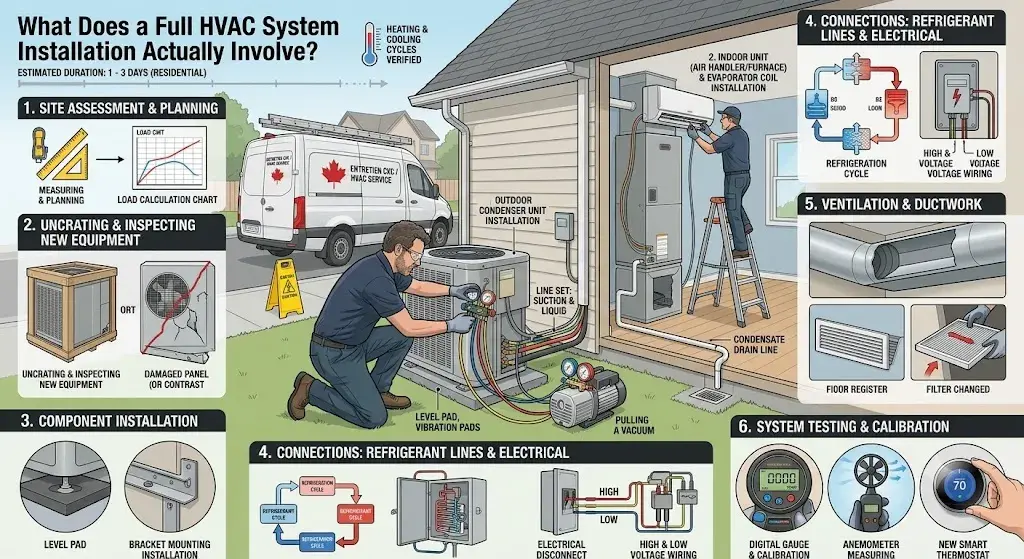
A full HVAC installation involves five core stages: a home assessment and load calculation, equipment selection and permitting, removal of the old system, physical installation of the new equipment and ductwork, and commissioning — testing, calibrating, and walking through the finished system. For a straightforward furnace or AC swap in Calgary, this typically takes one day. A full HVAC system replacement, new ductwork, or a heat pump conversion can take two to four days.
Most homeowners only think about HVAC installation as “the day the technician shows up,” but the work that happens before and after that day is what actually determines how well the system performs for the next 15–20 years. A rushed installation — wrong size, poor duct sealing, skipped commissioning — is one of the most common reasons a brand-new system still runs inefficiently or fails early. Here’s what a proper installation actually looks like, step by step.
Stage 1: Home Assessment and Load Calculation
Before any equipment is chosen, a qualified technician needs to understand your home’s actual heating and cooling needs — not just replace what’s already there. This stage includes:
- A full walkthrough of your home’s square footage, insulation levels, window count and orientation, ceiling height, and existing ductwork condition
- A Manual J load calculation — the industry-standard formula that determines exactly how much heating and cooling capacity your home needs, measured in BTUs
- An assessment of your existing ductwork, since even the best furnace or AC will underperform if it’s connected to undersized, leaky, or poorly designed ducts
This step is where a lot of lower-quality installs cut corners. Simply matching the size of your old unit — instead of running a proper load calculation — is one of the most common reasons homeowners end up with a system that’s too big (short-cycling, uneven temperatures) or too small (running constantly, never quite keeping up).
Stage 2: Equipment Selection and Permits
Once your home’s actual load is known, equipment selection comes down to matching your needs, budget, and efficiency goals:
- Sizing and efficiency ratings. Furnaces are rated by AFUE (Annual Fuel Utilization Efficiency), while air conditioners and heat pumps use SEER. Higher ratings mean lower operating costs but a higher upfront price — your installer should walk through this trade-off with actual numbers for your home.
- Fuel and system type. A gas furnace, electric furnace, heat pump, or a hybrid dual-fuel setup, depending on your home and priorities.
- Permits. In Alberta, HVAC installation typically requires separate gas and electrical permits under the province’s Safety Codes system, in addition to any mechanical permit for the equipment itself. A licensed contractor pulls these on your behalf — if a company skips this step to save time, it can create real problems later with insurance claims or when you sell the home.
This stage is also when financing gets finalized and installation is scheduled, ideally with enough lead time to order equipment rather than settling for whatever’s in stock during an emergency.
Stage 3: Removing the Old System
On installation day, the first job is safely disconnecting and removing the existing equipment:
- Shutting off gas, electrical, and refrigerant lines safely
- Disconnecting and removing the old furnace, AC unit, or heat pump
- Proper disposal or recycling of the old equipment and any refrigerant, which has specific environmental handling requirements in Canada
- Inspecting the space for anything that needs to be addressed before the new system goes in — old venting, damaged flooring, or outdated wiring
Stage 4: Installing the New Equipment and Ductwork
This is the stage most people picture when they think of “HVAC installation,” and it’s where the bulk of the physical work happens:
- Setting and securing the new furnace, AC condenser, or heat pump in place, matched to manufacturer specifications
- Running or modifying ductwork as needed — sealing joints, correcting undersized runs, and balancing airflow between rooms
- Connecting gas lines, electrical wiring, and refrigerant lines, all to current code
- Installing or reconnecting the thermostat, including any smart thermostat setup
- Venting and flue work, particularly important for high-efficiency furnaces that use different venting than older models
For a straightforward system swap with existing, compatible ductwork, this stage typically takes most of one day. Adding new ductwork, converting to a heat pump, or working in an older home with outdated infrastructure extends the timeline to two or three days.
Stage 5: Commissioning — Testing, Calibration, and Walkthrough
This is the step that separates a professional installation from a rushed one, and it’s the one most likely to get skipped by a lower-quality contractor:
- Airflow testing to confirm each room is getting proper heating and cooling
- Temperature differential testing, checking that the system is actually hitting its rated performance
- Refrigerant charge verification for AC and heat pump systems
- Safety checks, including carbon monoxide testing on gas furnaces and confirming proper venting
- Thermostat calibration and programming
- A full walkthrough with the homeowner covering how to operate the system, filter locations and replacement schedule, and what maintenance the warranty requires — see our guide on how often HVAC maintenance should be scheduled to stay on top of it after installation
Skipping commissioning doesn’t cause an immediate problem — the system will usually run. But it’s the difference between a system running at its rated efficiency and one quietly underperforming (and costing more to run) for its entire lifespan.
How Long Does HVAC Installation Actually Take?
| Installation Type | Typical Timeline |
| Furnace replacement (existing ductwork) | 1 day |
| AC installation (existing ductwork) | 1 day |
| Heat pump installation | 1–2 days |
| Full system replacement (furnace + AC) | 1–2 days |
| New or modified ductwork required | 2–4 days |
| Older home requiring infrastructure updates | 3–5 days |
Calgary adds a few local variables to this timeline. Installations during extreme cold snaps require specific cold-weather procedures for any outdoor work, which can add time. Homes in newer developments often have HVAC rough-ins already in place, which speeds things up, while older inner-city homes sometimes need more extensive ductwork or electrical updates before a modern system can go in.
What Does HVAC Installation Cost in Calgary?
Cost depends heavily on system type, home size, and whether ductwork needs work:
- Furnace installation: typically $3,500–$7,000 depending on efficiency rating and home size
- Central AC installation: typically $4,500–$8,000
- Heat pump installation: typically $6,000–$14,000, depending on system type and whether it’s replacing existing ductwork-based equipment
These are general ranges — the only way to get an accurate number is a proper in-home assessment, since ductwork condition and home size affect the final price as much as the equipment itself. If budget is a concern, flexible financing options can spread the cost of a full system installation over time. You can also see our full range of HVAC installation and service options in Calgary for a side-by-side look at furnace, AC, and heat pump installation.
Questions to Ask Before You Book an HVAC Installation
- Will you run a Manual J load calculation, or size based on my existing equipment?
- Are gas and electrical permits included, and who pulls them?
- What’s included in commissioning after the equipment is installed?
- What warranty covers the installation itself, separate from the manufacturer’s equipment warranty?
- How long will the job take, and what happens if it runs longer than expected?
A contractor who answers these clearly and specifically — not with vague reassurance — is a good sign the installation will be done properly.
Frequently Asked Questions
What are the main steps in HVAC installation?
Home assessment and load calculation, equipment selection and permitting, removal of the old system, installation of the new equipment and ductwork, and commissioning — testing, calibration, and a homeowner walkthrough.
How long does a full HVAC installation take?
A straightforward furnace or AC replacement with existing ductwork typically takes one day. Heat pump installations or full system replacements usually take one to two days, and jobs requiring new ductwork can take three to five days.
Do I need a permit for HVAC installation in Calgary?
Yes. Alberta’s Safety Codes system generally requires separate gas and electrical permits for HVAC installation, in addition to a mechanical permit for the equipment. A licensed contractor should handle this as part of the job.
What is a Manual J load calculation, and why does it matter?
It’s the industry-standard formula for determining exactly how much heating and cooling capacity a home needs. Skipping it and simply matching the size of the old system is one of the most common causes of an oversized or undersized — and inefficient — new installation.
What happens during HVAC commissioning?
Commissioning includes airflow and temperature testing, refrigerant charge verification, safety and carbon monoxide checks, thermostat calibration, and a full walkthrough of system operation and maintenance requirements.
Planning an HVAC Installation in Calgary?
ProStar Plumbing & Heating has installed furnaces, air conditioners, and heat pumps across Calgary, Bearspaw, Springbank, Crowfoot, and Westhills since 1996 — with proper load calculations, full permitting, and complete commissioning on every job, backed by industry-leading warranties.
Call 403-250-7232 or book a free in-home assessment to find out exactly what your home needs.