
Quick Answer: To choose the right HVAC contractor in Calgary, verify their trade certification and insurance, check local reviews and references, get at least three written itemized quotes, confirm labor and manufacturer warranties, and ask direct questions about licensing, timelines, and pricing before signing anything. Avoid contractors who won’t provide documentation or pressure you into same-day decisions.
Your furnace fails on the coldest night of the year, or your AC gives out mid-July, and suddenly you’re searching “HVAC contractor near me” and calling the first three numbers that show up. It’s an understandable way to end up with the wrong company — but it’s also how homeowners end up with an oversized furnace, a sloppy install, or a warranty that turns out not to cover what they thought it did.
Calgary’s climate doesn’t leave much margin for error. Winters regularly drop below -20°C, Chinook winds can swing temperatures 20 degrees in a single afternoon, and the city’s elevation (over 1,000 metres above sea level) actually affects how furnaces need to be calibrated for proper combustion. An HVAC system installed or repaired by someone unfamiliar with these conditions can underperform for years without you ever knowing why.
This guide walks through exactly what to check, what to ask, and what to avoid before you hire — so the decision is based on more than who answered the phone first.
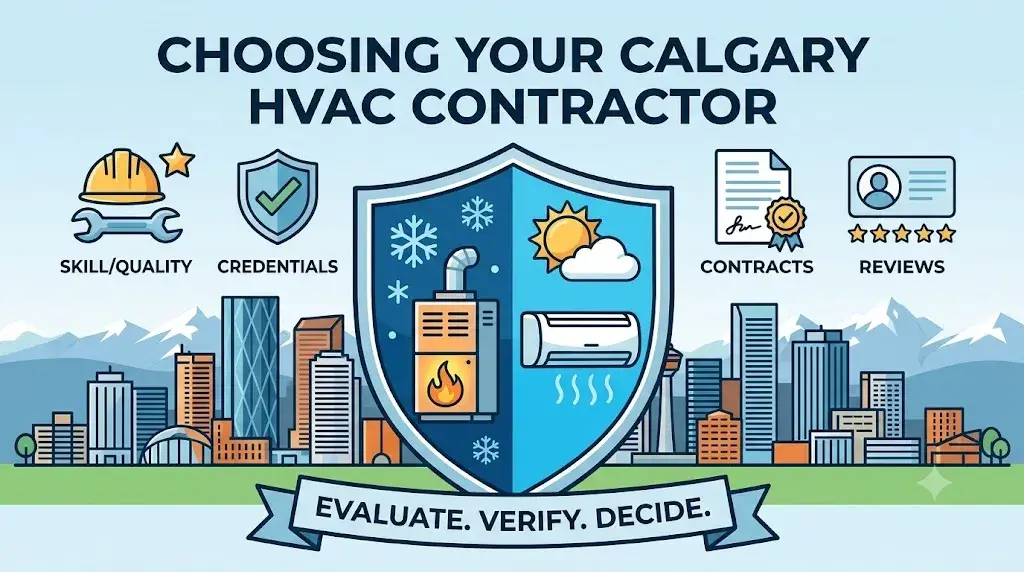
Quick Checklist: What to Verify Before You Hire
Before the details, here’s the short version:
- Valid Alberta trade certification (Gasfitter and/or Refrigeration & Air Conditioning Mechanic)
- Active City of Calgary business license
- General liability insurance and WCB coverage
- Local reviews and at least one verifiable reference
- A written, itemized quote — not a verbal estimate
- Clear labor warranty separate from the manufacturer’s equipment warranty
- A physical business address and a real phone number, not just a lead-gen form
If a contractor can’t check every box above without hesitation, keep looking.
Why Your Choice of Contractor Matters More in Calgary
HVAC work isn’t just installing a box and connecting a vent. It involves gas lines, electrical wiring, combustion safety, and equipment that has to be sized correctly for your home’s insulation, ductwork, and square footage — get any of that wrong and you’re looking at higher energy bills, uneven heating, or a system that fails years before it should.
Calgary adds a layer most Canadian cities don’t deal with: altitude. Furnaces need to be adjusted for the reduced oxygen at elevation, and a technician unfamiliar with high-altitude combustion settings can leave you with a furnace that’s technically installed but never actually tuned for your home. Add in Chinook-driven temperature swings and long stretches of extreme cold, and the case for hiring someone with real local experience — not just a license — gets a lot stronger.
Step 1: Verify Licensing, Certification, and Insurance
This is the step homeowners skip most often, and it’s the one that matters most.
In Alberta, HVAC technicians working on gas appliances are required to hold a Gasfitter certification (Class A or Class B), and many also carry Refrigeration and Air Conditioning Mechanic credentials. Both are regulated under Alberta’s Skilled Trades and Apprenticeship Education Act.
Here’s what most guides don’t tell you: you can actually verify this yourself. Alberta’s Tradesecrets website has a public “Check Your Tradesperson’s Certificate” tool that lets you confirm whether someone holds a valid Alberta journeyperson certificate, and in which trade. It takes about 30 seconds and removes all guesswork — legitimate contractors won’t hesitate to give you the name on their certificate so you can check.
Beyond trade certification, confirm:
- An active City of Calgary business license
- General liability insurance — $1–2 million in coverage is standard for residential HVAC work
- WCB (Workers’ Compensation Board) coverage for all technicians who’ll be in your home
- The ability to pull required HVAC permits under the Alberta Safety Codes Act, for any job that requires one
A reputable HVAC company in Calgary will produce this documentation without being asked twice.
Step 2: Check Local Experience, Reviews, and References
Licensing tells you a contractor is allowed to do the work. Reviews and references tell you whether they’re good at it.
Look specifically for:
- Google reviews mentioning the exact service you need (installation vs. repair vs. maintenance)
- How the company responds to negative reviews — professionally, or defensively
- Whether they have documented experience with your specific brand or system type
- At least one or two references you can actually call, ideally other Calgary homeowners
Local experience matters more than it might seem. A contractor who’s worked through several Calgary winters knows how ductwork behaves in older Calgary homes, understands which furnace models hold up best against altitude and Chinook cycling, and is familiar with the city’s permitting process — all things a newer or out-of-town company won’t have picked up yet.
Step 3: Get Written, Itemized Quotes — From More Than One Company
A verbal ballpark number is not a quote. Before any work starts, you should have a written estimate that itemizes:
- Exact equipment make and model (not just “furnace” or “AC unit”)
- Labor costs separate from equipment costs
- Permit fees, if applicable
- Manufacturer and labor warranty terms
- Total project cost with no vague “additional fees may apply” language
It’s standard practice to collect at least three quotes before deciding. This isn’t about chasing the lowest number — it’s about comparing scope. Two quotes for “furnace installation” can vary by thousands of dollars because one includes ductwork modifications and a 10-year labor warranty, and the other doesn’t. Compare what’s actually included before you compare price.
Step 4: Review Warranties and Maintenance Options
Every HVAC installation comes with two separate warranties: the manufacturer’s warranty on the equipment itself, and the labor warranty from the company that installed it. A contractor who only mentions one is only telling you half the story — a failed part covered by the manufacturer doesn’t help if you’re still paying full price for the labor to replace it.
Ask directly:
- How long is the labor warranty, and what does it cover?
- Is the manufacturer’s warranty void if I don’t use their maintenance plan?
- What seasonal maintenance plans do you offer for furnace maintenance, AC maintenance, or heat pump upkeep?
A company that can answer all three clearly, without hedging, is one that stands behind its own work.
Step 5: Ask These Questions Before You Sign Anything
Most guides tell you to “ask good questions” without saying what those questions actually are. Here’s a script you can use on the phone or during an in-home consultation:
- Can you provide your Alberta trade certificate number so I can verify it?
- Do you carry liability insurance and WCB coverage — can I see proof?
- Will you provide a written, itemized quote before any work begins?
- What’s included in your labor warranty, and for how long?
- Have you worked on this brand/model before?
- Will the same technician handle installation and any follow-up service?
- Do you pull permits directly, or is that my responsibility?
- What’s your typical timeline for a job like mine?
- Are there financing options available if this is a larger installation?
- Can you give me two references from Calgary customers?
A confident, experienced contractor will answer all ten without missing a beat. Hesitation, vague answers, or pushback on any of these is worth paying attention to.
Red Flags to Watch For
Walk away from any HVAC contractor who:
- Can’t produce a trade certificate or insurance documentation on request
- Gives only verbal quotes, or refuses to itemize a written one
- Pressures you to sign the same day with a “deal expires tonight” pitch
- Has no physical business address or a scattered, inconsistent online presence
- Quotes a price significantly lower than every other estimate with no clear explanation
- Recommends a full system replacement before ruling out a repair, especially on equipment under 10–12 years old
- Can’t or won’t explain what’s included in the labor warranty
None of these alone is necessarily disqualifying, but two or more together is a strong signal to keep looking.
Local Contractor vs. National Chain: Does It Matter?
It can. A locally established Calgary HVAC company has usually already solved the problems specific to this climate — altitude-adjusted combustion, Chinook-related cycling stress on equipment, and older Calgary-area ductwork. National franchises can still do good work, but you’ll want to confirm the technician dispatched to your home has actual Calgary experience, not just general HVAC training. Community reputation also tends to mean more to a local, family-run company — see how long a company has served Calgary and what past customers say before deciding.
If you’re weighing this decision alongside other home services, the same due-diligence approach applies — see our guide on questions to ask a plumber before hiring them for the plumbing side of the equation.
Frequently Asked Questions
How do I know if an HVAC contractor is licensed in Alberta?
Ask for their trade certificate number and verify it directly through Alberta’s Tradesecrets “Check Your Tradesperson’s Certificate” tool. It confirms whether the person holds a valid Alberta journeyperson certificate and which trade they’re certified in.
How many quotes should I get before hiring an HVAC contractor?
At least three. Compare scope of work, not just price — two similar-looking quotes can include very different levels of service, warranty coverage, and equipment quality.
Is it worth hiring a local Calgary HVAC company over a national chain?
Often, yes. Local companies tend to have hands-on experience with Calgary’s altitude, Chinook cycles, and older home ductwork — factors that affect how a system should be installed and maintained here specifically.
What’s the difference between a manufacturer’s warranty and a labor warranty?
The manufacturer’s warranty covers defective equipment or parts. The labor warranty, provided by the installing contractor, covers the cost of the technician’s time to diagnose and fix an issue. You need both to be fully protected.
Should I choose an HVAC contractor who also handles plumbing?
It can simplify things, especially for jobs where systems overlap — a water heater tied into a furnace’s venting, for example. A combined plumbing and HVAC provider can also mean one point of contact instead of coordinating multiple companies.
Final Thoughts
Choosing the right HVAC contractor in Calgary comes down to verification, not gut instinct. Check the license, read the reviews, get the quote in writing, and ask the questions above before anyone starts working on your system. A company with nothing to hide will make all of this easy — and that ease is itself one of the best signals you’re hiring the right one.
Looking for a licensed, Calgary-based team for your next furnace, heat pump, or AC project? See ProStar’s full HVAC services or get in touch for a written quote.