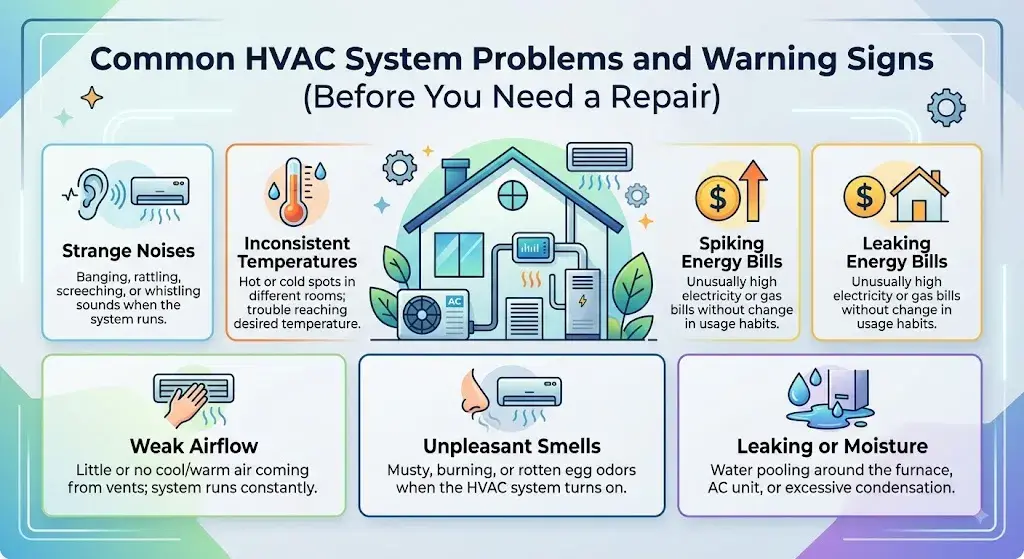
Most HVAC breakdowns don’t happen out of nowhere. In the weeks before a furnace quits or an air conditioner stops cooling, your system almost always gives you a warning — a strange noise, a spike in your energy bill, a room that’s never quite the right temperature. The homeowners who catch these signs early spend far less than the ones who wait for a full breakdown.
This guide walks through the most common HVAC problems Calgary homeowners run into, what’s actually causing them, and when a sign means “keep an eye on it” versus “call someone today.”
Quick Answer: What Are the Most Common HVAC Problems?
The most common HVAC problems include weak or uneven airflow, unusual noises, short cycling (turning on and off repeatedly), rising energy bills, a system that won’t turn on, and warm or cold spots between rooms. Most of these start as minor issues but worsen into full breakdowns if left unaddressed.
Why HVAC Problems Are Easy to Miss Early On
HVAC systems tend to fail gradually rather than all at once. A furnace losing efficiency doesn’t stop heating your home overnight — it just runs longer, costs more, and heats less evenly until one part finally gives out. That gradual decline is exactly why so many Calgary homeowners are surprised by a mid-winter breakdown that, in hindsight, had been building for months.
Knowing what to watch for is the difference between a $150 repair and a $6,000+ emergency replacement.
7 Common HVAC Problems and What They Mean
1. Weak or Uneven Airflow
If some rooms feel noticeably warmer or cooler than others, or airflow from your vents feels weaker than it used to, the cause is usually one of a few things: a clogged air filter restricting airflow, blocked or leaking ductwork, a failing blower motor, or a system that’s undersized for your home. Weak airflow is also one of the first signs of a frozen evaporator coil in central air systems.
What to do: Start by checking your filter — a clogged filter is the single most common cause and the easiest to fix yourself. If airflow is still weak after a fresh filter, it’s worth having a technician inspect your ductwork and blower motor.
2. Strange Noises From Your HVAC System
A healthy HVAC system should run quietly in the background. Banging, rattling, squealing, or grinding noises usually point to a specific mechanical issue: loose or worn belts, a failing motor bearing, a loose panel, or in more serious cases, a compressor problem in your air conditioner.
What to do: Don’t ignore new noises, even quiet ones. Catching a loose belt early costs a fraction of what a full compressor replacement does. If your furnace specifically is making unusual sounds, our guide to the warning signs you need furnace repair explains what the most common noises usually point to.
3. Short Cycling (Turning On and Off Repeatedly)
Short cycling — where your system turns on, runs briefly, then shuts off before completing a full heating or cooling cycle — is hard on your equipment and a sign something’s wrong. Common causes include a dirty air filter, a malfunctioning thermostat, an oversized system, or overheating components that trigger a safety shutoff.
What to do: This one shouldn’t wait. Frequent short cycling accelerates wear on your compressor or heat exchanger and often signals a problem that will worsen quickly without attention.
4. Rising Energy Bills Without a Clear Reason
If your utility bills are climbing but your usage habits haven’t changed, your HVAC system is likely losing efficiency. This can come from dirty coils, worn-out components, leaky ductwork, or a system that’s simply aging out and working harder to hit the same temperature.
What to do: Compare your current bill to the same month last year. A consistent, unexplained increase of 10–15% or more is a strong signal your system needs a maintenance visit or a broader efficiency inspection.
5. Your HVAC System Won’t Turn On
A system that won’t start at all is usually an electrical or thermostat issue rather than a full mechanical failure — though it’s important not to assume that without a proper inspection. Common causes include a tripped breaker, a dead thermostat battery, a blown fuse, or a failed capacitor.
What to do: Check your thermostat batteries and breaker panel first — these are quick fixes. If the system still won’t start, avoid repeated attempts to force it on, since this can damage electrical components further.
6. Thermostat Isn’t Responding Accurately
If your thermostat display is blank, unresponsive, or your home’s actual temperature doesn’t match what it’s set to, the issue could be as simple as dead batteries or as involved as faulty wiring or a sensor malfunction. Smart thermostats can also lose connectivity, which sometimes mimics a system failure that isn’t actually there.
What to do: Replace batteries and restart the thermostat first. If problems persist, the issue may be with the wiring connecting it to your HVAC system rather than the thermostat itself.
7. Musty or Burning Smells From Vents
A musty smell usually points to mold or moisture buildup somewhere in your ductwork or system — often tied to indoor air quality issues. A burning smell is more urgent and can indicate an electrical problem, an overheating motor, or dust burning off a component after a long period of inactivity (common the first time you turn on your furnace each fall).
What to do: A brief burning smell when you first start your furnace for the season is usually normal dust burn-off and clears within an hour. A persistent burning smell, or any musty odor that keeps returning, warrants a professional inspection.
8. An Aging System That’s Working Harder Than It Should
Most furnaces last 15–20 years and air conditioners 10–15 years, but age alone isn’t always the deciding factor — how consistently a system was maintained matters just as much. An aging system often shows a combination of the signs above at once: rising bills, more frequent repairs, uneven temperatures, and longer run times to reach the same comfort level.
What to do: If your system is approaching the upper end of its expected lifespan and you’re noticing two or more warning signs from this list, it’s worth getting a professional opinion on repair versus replacement before a peak-season breakdown forces the decision for you. Our guide on how much it costs to replace a furnace in Calgary can help you plan ahead financially.
Common HVAC Problems by System Type
| System | Most Common Problem | Where to Learn More |
| Furnace | Short cycling, no heat, strange noises | Warning signs it’s time to replace your furnace |
| Air Conditioner | Weak cooling, frozen coil, refrigerant leak | AC not cooling: causes and fixes |
| Heat Pump | Reduced efficiency in extreme cold, icing | Heat pump pros and cons |
| Thermostat | Inaccurate readings, connectivity loss | Indoor air quality thermostat guide |
| Ductwork | Uneven airflow, dust buildup, odors | Duct cleaning services |
When a Warning Sign Means “Call Today”
Most of the issues above can wait for a scheduled appointment. A few can’t. Call a technician the same day if you notice:
- A burning smell that doesn’t clear after an hour
- No heat during extreme cold (below -20°C)
- Visible sparking, smoke, or an electrical burning smell
- Water pooling around your furnace or AC unit
- Complete system failure with no response to thermostat changes
For situations like these, our guide on top warning signs you need furnace repair immediately covers exactly what qualifies as an emergency versus what can reasonably wait until morning.
How Regular Maintenance Prevents Most of These Problems
The majority of the issues on this list share a common root cause: a system that hasn’t been maintained on a regular schedule. Routine maintenance catches worn belts, low refrigerant, dirty coils, and failing components before they cause a breakdown — which is why most manufacturers recommend two visits per year: one for your heating system in fall, one for cooling in spring.
If you’re not sure when your system was last serviced, our guides on how often to schedule furnace maintenance and identifying the best time for HVAC tune-ups can help you figure out where you stand, and our full furnace maintenance checklist shows exactly what a proper visit should cover.
What It Costs to Ignore These Warning Signs
Deferring an HVAC repair rarely saves money — it usually just shifts a small repair into a much larger one. A dirty filter left unaddressed forces your blower motor to work harder, shortening its lifespan. A refrigerant leak that goes unnoticed can lead to compressor damage, which is often expensive enough to make full AC replacement the more sensible choice. A furnace short cycling for months puts repeated stress on the heat exchanger, the single most expensive component to replace.
The pattern is consistent: a $150–$300 repair caught early becomes a $1,500–$6,000+ replacement when ignored for a full season or more. Regular attention to the warning signs above is almost always the cheaper path.
When to DIY vs. When to Call a Professional
A short list of things are safe to check yourself: air filters, thermostat batteries, breaker switches, and visible obstructions around outdoor units. Everything beyond that — refrigerant, electrical components, gas connections, or internal mechanical parts — should be left to a licensed technician. Attempting DIY repairs on these components isn’t just risky for your system; it can void your warranty and, in the case of gas furnaces, create a genuine safety hazard.
Frequently Asked Questions
What are the most common HVAC problems?
The most common HVAC problems are weak airflow, unusual noises, short cycling, rising energy bills, a system that won’t turn on, and inconsistent temperatures between rooms. Most start small and worsen without maintenance.
How do I know if my HVAC system is failing?
Watch for a combination of signs rather than just one — rising bills alongside weaker airflow, or short cycling paired with strange noises, usually indicates a system nearing the end of its efficient lifespan rather than a single isolated issue.
Why is my HVAC system not working properly?
The most frequent causes are a dirty air filter, low refrigerant, thermostat malfunctions, or electrical issues like a tripped breaker or failed capacitor. A professional inspection can pinpoint the exact cause.
Can I fix common HVAC problems myself?
Some, like replacing a filter or thermostat batteries, are safe DIY fixes. Anything involving refrigerant, gas lines, or electrical components should be handled by a licensed HVAC technician for safety and warranty reasons.
How often should I get my HVAC system inspected to avoid problems?
Most homes benefit from two inspections per year — one for the heating system before winter and one for cooling before summer — to catch small issues before they become costly repairs.
Don’t Wait for a Full Breakdown
Catching these warning signs early is the easiest way to avoid an emergency repair — and a much bigger bill. If you’re noticing any of the issues above, ProStar’s licensed technicians provide thorough inspections and honest, flat-rate pricing across Calgary, Bearspaw, Springbank, Crowfoot, and West Hills.
Explore our full range of HVAC services in Calgary, or contact us to book an inspection before small problems turn into costly ones.