
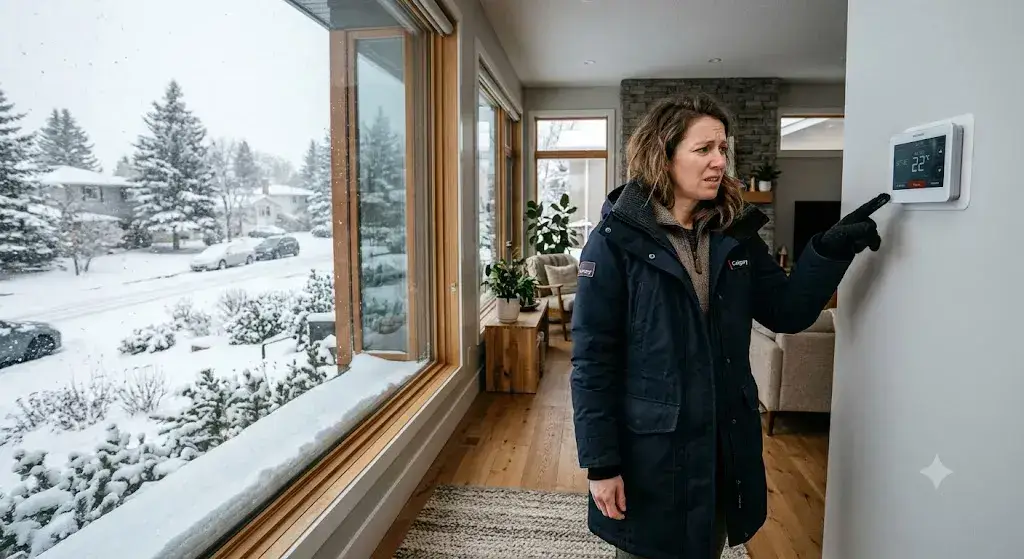
A heat pump that is not heating in a Calgary winter is most often caused by thermostat settings, a dirty air filter, a tripped breaker, ice on the outdoor unit, or extreme cold limiting its capacity. A stuck reversing valve, low refrigerant, or failed electrical parts need a technician. Run the quick checks below first, and if your heat pump still blows cool air, book heat pump repair in Calgary.
When the house is getting cold and the outdoor unit is buried in frost, it’s easy to assume the worst. In many cases the fix takes minutes. In others, it’s a sign of a problem that gets more expensive the longer it runs. This guide explains how to tell which one you’re dealing with.
Heat Pump Not Heating: Quick Answer
| Cause | What you notice | DIY or pro? |
|---|---|---|
| Wrong thermostat settings | Cool air, system running but no warmth | DIY |
| Tripped breaker or no power | Unit completely silent | DIY (once), then pro |
| Dirty air filter | Weak airflow, long run times | DIY |
| Ice or snow on the outdoor unit | Frost, thick ice, or a buried unit | DIY (clearing), pro if it returns |
| Extreme cold limiting capacity | Heat output drops on the coldest days | Pro, to check backup heat |
| Low refrigerant or a leak | Weak heat, ice on lines, hissing | Pro |
| Stuck reversing valve | Cool air in heating mode, works in cooling | Pro |
| Failed electrical or mechanical parts | Humming, clicking, fan not spinning | Pro |
Is It Normal for a Heat Pump to Blow Cooler Air?
Sometimes, yes. A heat pump moves heat instead of burning fuel, so the air from your vents is warm but not hot. Typical heat pump supply air is around 29 to 38°C, compared with roughly 49 to 60°C from a gas furnace. That can feel cool on your hand even when the system is working properly.
The real question is whether your home reaches the temperature you set. If the house keeps getting colder while the heat pump runs, something is wrong.
5-Minute Checks Before You Call a Technician
- Check the thermostat. Make sure it’s set to Heat (not Cool or Auto), the set point is a few degrees above room temperature, and the batteries are fresh.
- Set the fan to Auto. If the fan is set to On, the system can blow cool air between heating cycles.
- Check your breakers and the outdoor disconnect. Reset a tripped breaker once. If it trips again, stop and call a technician.
- Replace or clean the air filter. A clogged filter restricts airflow and cuts heating output.
- Look at the outdoor unit. Clear snow drifts and light frost from around it. Don’t chip ice with tools or use hot water.
- Wait through a defrost cycle. Steam and a short pause in heating can be normal. If heating doesn’t resume after about 15 minutes, move on to the causes below.
8 Common Causes of a Heat Pump Not Heating
1. Incorrect Thermostat Settings
This is the most common reason a heat pump seems to fail. The thermostat may be in Cool or Auto mode, the schedule may have switched to a lower temperature, or the batteries may be dead. Smart thermostats can also lose their connection or reset after a power flicker.
What to do: Switch to Heat, raise the set point, and give the system 15 minutes. Heat pumps warm a home gradually, so don’t expect the blast of heat a furnace gives.
2. Tripped Breaker or Power Problem
A heat pump has an indoor unit and an outdoor unit, and each can have its own breaker and disconnect switch. If either loses power, the system won’t heat properly.
What to do: Check the electrical panel and the outdoor disconnect. Reset a tripped breaker once. A breaker that trips repeatedly points to a failing motor, capacitor, or wiring fault, which is a job for a licensed technician.
3. Dirty or Clogged Air Filter
A dirty filter chokes airflow across the indoor coil. The system struggles to deliver heat, runs longer, and can even ice up. In winter, when the system runs most of the day, filters clog faster.
What to do: Check the filter monthly during heating season and replace it when it looks gray or clogged.
4. Ice or Snow on the Outdoor Unit
Some frost on the outdoor coil is normal in cold, damp weather. Heat pumps run a defrost cycle that briefly reverses the system to melt it. A problem exists when ice stays thick, covers the whole coil, or comes back right after defrosting.
In Calgary, Chinook swings make this worse. Snow melts during the day, refreezes overnight, and can bury or encase the outdoor unit.
What to do: Keep about 60 cm of clear space around the unit and keep drifts off it. Never use a hammer, ice pick, or boiling water, because you can damage the coil. If ice keeps returning, the defrost control, sensor, or reversing valve may have failed. Our guide to common HVAC problems and warning signs in Calgary covers related symptoms.
5. Extreme Cold Limiting Heat Output
Heat pumps can keep running in very low temperatures, but the amount of heat they deliver drops as it gets colder. Installers in Alberta generally recommend pairing a heat pump with a backup heat source for the coldest days. If your home gets cold during a -25°C snap, the heat pump may simply be at its limit.
What to do: If your system is dual-fuel, the furnace should take over below a set changeover temperature. If it isn’t doing that, or if the house is still cold with backup running, the thermostat setup, the control board, or the system size needs checking. Our team can look at both your furnace and heat pump in one visit. Not sure whether a heat pump suits your home at all? Read our heat pump pros and cons.
6. Low Refrigerant or a Refrigerant Leak
Refrigerant carries heat between outdoors and indoors. If the level is low, the system can’t move enough heat. Signs include weak heating, ice on the refrigerant lines or indoor coil, a hissing sound, and rising energy bills.
What to do: Refrigerant work requires a licensed technician and specialized tools. Topping it up without fixing the leak only delays the problem. For typical pricing, see our guide to heat pump repair cost in Calgary.
7. Stuck Reversing Valve
The reversing valve switches your system between heating and cooling. If it sticks, the heat pump may blow cool air in heating mode, even though it works fine in summer cooling mode.
What to do: This is a professional repair. Replacing a reversing valve involves handling refrigerant and brazing, and it isn’t a DIY job.
8. Failed Electrical or Mechanical Parts
Capacitors, contactors, outdoor fan motors, defrost control boards, and compressors all wear out, and cold weather puts extra stress on them. Symptoms include humming without starting, clicking, an outdoor fan that won’t spin, or a unit that shuts off shortly after starting.
What to do: Turn the system off at the thermostat and call a technician. Running a heat pump with a failing motor or compressor can turn a small repair into a large one.
Why Calgary Winters Make Heat Pump Problems More Common
Calgary’s winters are harder on heat pumps than milder climates. Sub-zero stretches keep the system running for long periods, Chinooks create melt-and-refreeze cycles around the outdoor unit, and sudden cold snaps push the system to its capacity limit. All of this means small issues, like a dirty filter, a weak capacitor, or a slow refrigerant leak, tend to show up in the coldest weeks of the year.
If your home has a gas furnace as backup, keep it in good shape too. A heat pump that struggles in extreme cold relies on the furnace to pick up the slack. Book furnace maintenance before winter, and if your backup system acts up, read what to do if the furnace stops working. Our winter-proofing checklist is also a good place to start.
When to Call a Pro for a Heat Pump Not Heating
Call a licensed technician if:
- The heat pump still blows cool air after the quick checks above
- Ice covers the outdoor coil or returns soon after clearing
- A breaker trips repeatedly
- You hear hissing, grinding, banging, or loud humming
- You notice a burning smell (turn the system off right away)
- The house is getting too cold and the backup heat isn’t keeping up
- The system works in cooling mode but not in heating mode
If the temperature is dropping and you don’t have working backup heat, treat it as urgent. Our team can diagnose the problem and explain your options before any work begins. See our 10 signs you need to repair your home heating system for more on when to act quickly.
How to Prevent Your Heat Pump From Failing in Winter
- Book a tune-up in the fall. A technician can catch worn capacitors, low refrigerant, and dirty coils before the cold hits. See how often HVAC maintenance is needed in Calgary and the best time for HVAC tune-ups.
- Replace filters on schedule. Check monthly in winter.
- Keep the outdoor unit clear. Remove snow and debris, and leave space around it for airflow.
- Don’t ignore early warning signs. Odd noises, longer run times, and rising energy bills usually appear before a breakdown.
- Know your backup plan. Make sure your furnace or backup heat is working before the first deep freeze.
Frequently Asked Questions
Why is my heat pump blowing cold air in heat mode?
Common causes are a thermostat set to Cool, the fan set to On, an active defrost cycle, a dirty filter, low refrigerant, or a stuck reversing valve. Check the thermostat and filter first. If the air stays cool, call a technician.
How cold can a heat pump work in Calgary?
Cold-climate heat pumps can keep running at around -30°C, but their heating capacity drops as temperatures fall. Most Calgary homes pair a heat pump with a gas furnace or other backup heat for the coldest days.
Should I use emergency heat on my heat pump?
Only if the heat pump has stopped heating. Emergency heat uses backup electric elements or your furnace, which costs more to run. If you needed it, have the heat pump checked rather than leaving it on for days.
Is it normal for a heat pump to run all the time in winter?
Long run times are normal in cold weather because heat pumps heat gradually. If it runs constantly and the house still can’t reach the set temperature, there may be an airflow, refrigerant, or sizing problem.
How long does a heat pump defrost cycle last?
A normal defrost cycle typically lasts a few minutes up to about 15 minutes. You may see steam from the outdoor unit and feel cooler air from the vents. If heating doesn’t resume, or ice keeps building, call for service.
Can I fix a heat pump that isn’t heating myself?
You can check the thermostat, breakers, filter, and clear snow from the outdoor unit. Anything involving refrigerant, the reversing valve, or electrical parts should be handled by a licensed technician.
How much does it cost to repair a heat pump that isn’t heating?
Most heat pump repairs in Calgary run roughly $200 to $900, but major repairs such as a compressor can cost more. Read our full guide to heat pump repair cost in Calgary.
Related Services and Guides
- Heat pump repair in Calgary
- Heat pump installation
- HVAC services
- Furnace repair
- Furnace not heating: how to troubleshoot common heating issues
- How to choose an HVAC contractor in Calgary
Need Heat Pump Repair in Calgary?
A licensed and insured team serving Calgary since 1996, ProStar Plumbing & Heating will find out why your heat pump isn’t heating, explain the problem in plain language, and give you a clear price before we start. Book heat pump repair in Calgary or contact us with questions.
We also serve homeowners in Airdrie, Cochrane, Chestermere, Okotoks, Springbank, and Bearspaw. See all service areas.