
A full HVAC installation has five stages: a home assessment and heat loss calculation, equipment selection and permits, removal of the old system, installation of the new equipment and ductwork, and commissioning (testing, calibration and a homeowner walkthrough). A standard furnace or AC swap in Calgary usually takes one day. Heat pump conversions, new ductwork and older homes can take two to five days.
Most homeowners think of HVAC installation as “the day the crew shows up.” The work before and after that day is what decides how well the system performs for the next 10 to 20 years. Furnaces commonly last 15 to 20 years, and air conditioners and heat pumps closer to 10 to 15. A rushed installation, with the wrong size, leaky ducts or skipped commissioning, is one of the most common reasons a brand-new system still runs poorly or fails early.
This guide walks through each stage, what it should include, how long it takes in Calgary, what it costs, and what to ask before you book.
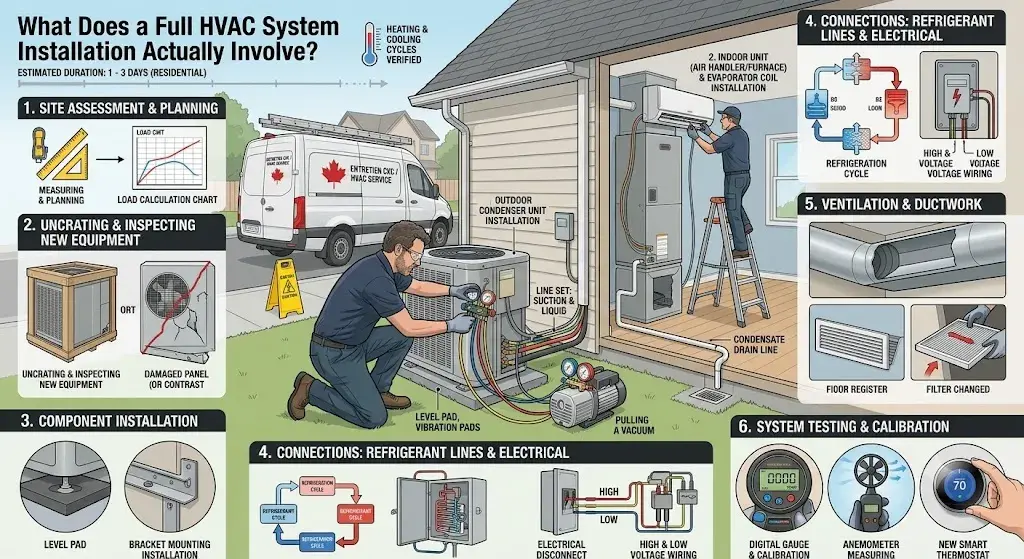
Stage 1: Home Assessment and Load Calculation
Before any equipment is chosen, a qualified technician needs to understand your home’s actual heating and cooling needs, not just replace what’s there. This stage includes:
- A full walkthrough of square footage, insulation levels, windows, ceiling heights, air leakage and the condition of your existing ductwork
- A load calculation. In Canada, residential heating and cooling equipment is sized using CSA F280, the Canadian counterpart to the U.S. Manual J method. Both estimate your home’s heat loss in winter and heat gain in summer from its insulation, windows, air leakage and local climate data, and convert the result into BTUs
- A ductwork check, including airflow and static pressure. Even the best furnace or AC underperforms on undersized, leaky or poorly designed ducts
This is where lower-quality installs cut corners. Matching the size of the old unit without a calculation is a common way to end up with a system that is too big (short-cycling, uneven temperatures, noise) or too small (running constantly and never catching up). In Calgary the old size is often wrong anyway, because many homes have had windows replaced, insulation added or a basement developed since the furnace went in.
Stage 2: Equipment Selection and Permits
Once your home’s load is known, equipment selection comes down to your needs, budget and efficiency goals:
- Efficiency ratings. Furnaces are rated by AFUE (Annual Fuel Utilization Efficiency). Air conditioners use SEER (SEER2 on newer ratings), and heat pumps add heating ratings. Higher ratings lower operating costs but raise the upfront price, so your installer should show you the trade-off with real numbers for your home.
- System type. A gas furnace, a heat pump, or a dual-fuel setup that pairs the two. See “Furnace, heat pump or dual-fuel?” below.
- Permits. The City of Calgary states that all furnace installations and replacements require a permit. A furnace replacement permit is issued to a qualified HVAC contractor and covers the appliance and venting. Other work, such as new electrical circuits for a heat pump or AC, may need an electrical permit. Your contractor should pull the permits and tell you which ones are included in your quote. In Calgary, homeowners can only apply for a gas permit if they are an Alberta certified journeyman gasfitter working on a single-family home. That is one reason furnace installation is not a DIY project. Skipped permits can cause problems with insurance claims or when you sell.
If you’re renovating, note that Alberta has required since May 1, 2017 that a replacement furnace not be used to heat a space undergoing renovation.
This stage is also when financing on new installations is arranged and the install date is set, ideally with enough lead time to order equipment rather than settling for whatever is in stock during an emergency.
Stage 3: Removing the Old System
On installation day, the first job is safely disconnecting and removing the existing equipment:
- Shutting off gas, electrical and refrigerant lines
- Disconnecting and removing the old furnace, AC unit or heat pump
- Recovering refrigerant with a trained technician and disposing of or recycling old equipment responsibly
- Inspecting the space for anything that must be fixed before the new system goes in, such as old venting, damaged flooring or outdated wiring
Stage 4: Installing the New Equipment and Ductwork
This is the stage most people picture, and it’s where most of the physical work happens:
- Setting and securing the new furnace, AC condenser or heat pump to manufacturer specifications
- Venting and condensate. High-efficiency furnaces vent through plastic pipe and produce condensate that must drain properly. In Calgary’s cold, that drain should be routed and protected so it can’t freeze
- Ductwork changes as needed: sealing joints, correcting undersized runs and balancing airflow between rooms
- Gas, electrical and refrigerant connections, all to current code, including a gas leak test
- Thermostat installation, including any smart thermostat setup
- Optional add-ons such as a humidifier or air cleaner (see our guide to indoor air quality services)
For a straightforward swap with compatible existing ductwork, this stage takes most of one day. New ductwork, a heat pump conversion or an older home with outdated infrastructure extends the job.
Stage 5: Commissioning — Testing, Calibration and Walkthrough
This step separates a professional installation from a rushed one, and it’s the one a lower-quality contractor is most likely to skip:
- Airflow and static pressure testing to confirm each room gets what it should
- Temperature rise (furnace) or temperature split (AC and heat pump) checks, confirming the system hits its rated performance
- Gas pressure and combustion checks on gas furnaces, plus carbon monoxide testing and confirmation that venting is correct
- Refrigerant charge verification for AC and heat pump systems
- Condensate drain test and thermostat calibration
- A full walkthrough covering how to operate the system, where the filters are and when to change them, and what maintenance your warranty requires. See how often HVAC maintenance should be scheduled
Skipping commissioning doesn’t cause an immediate problem, because the system will usually run. But it’s the difference between a system running at its rated efficiency and one quietly underperforming, and costing more to run, for its entire life. Ask your installer for the commissioning readings in writing.
How Long Does HVAC Installation Take in Calgary?
| Installation type | Typical timeline |
| Furnace replacement (existing ductwork) | 1 day (about 6–8 hours) |
| AC installation (existing ductwork) | 1 day |
| Furnace and AC together | 1–2 days |
| Heat pump installation (existing ductwork) | 1–2 days |
| Heat pump with electrical upgrade or dual-fuel setup | 2–3 days |
| New or modified ductwork | 2–4 days |
| Older home needing infrastructure updates | 3–5 days |
Calgary adds a few local variables. Installs during a cold snap need extra care for outdoor work, and ProStar uses temporary heaters to keep your home warm during winter installations. Newer developments often have HVAC rough-ins in place, which speeds things up, while older inner-city homes may need more extensive duct or electrical work before a modern system can go in.
How to Prepare for Installation Day
- Clear a path and at least a metre or so of working space around the furnace, AC and electrical panel
- Move stored items and anything fragile away from the work area and the route to the door
- Make sure the crew can park close to the house
- Plan for the power and gas to be off at points during the day
- Secure pets, and tell anyone working from home about the noise
- Confirm in writing which permits are included and when the inspection will happen
Furnace, Heat Pump or Dual-Fuel?
- Gas furnace: the familiar choice for Calgary winters, with strong output on the coldest days. See our furnace replacement options.
- Cold-climate heat pump: heats and cools from one system. Cold-climate models are designed to work well below freezing, but efficiency falls as temperatures drop, and in Calgary’s coldest snaps many homes keep a furnace or backup heat. Read our heat pump pros and cons for Calgary homes.
- Dual-fuel: a heat pump that hands off to a gas furnace when it gets cold outside, combining efficiency in mild weather with furnace power in deep cold.
The right answer depends on your load calculation, ductwork, electrical panel capacity and what you’re replacing. If you’re replacing a cooling system, see our AC replacement and AC installation pages.
How Much Does HVAC Installation Cost in Calgary?
These are planning ranges, and your final price depends on equipment, home size and ductwork:
| System | Typical installed cost in Calgary |
| High-efficiency furnace | About 5,000–8,000; premium modulating models run higher, around $10,000 |
| Central AC | About 4,500–8,000 |
| Heat pump (Alberta) | About 8,000–18,000 depending on type, capacity and electrical work |
What moves the price:
- Equipment efficiency and staging (single-stage, two-stage or modulating)
- Home size and your calculated load
- Duct repairs or changes, and complicated venting or relocating the furnace, which can add several hundred dollars or more
- Add-ons such as a humidifier, air cleaner or smart thermostat
- Whether the quote includes permits, old-equipment removal and commissioning
Ask for an itemized quote that lists all of that. For more detail, see our guides to the full cost of an HVAC system in Calgary and what it costs to replace a furnace in Calgary. Not sure whether to repair or replace? See the warning signs it’s time to replace your furnace, our repair-or-replace rule for AC, or our furnace repair page.
Signs of a Rushed or Poor Installation
- The quote is based on the old unit’s size, with no load calculation
- Nobody mentions permits, or says you “don’t need one”
- No commissioning readings or checklist, and no walkthrough
- Ductwork problems are ignored even though rooms are uneven
- No written labour warranty, separate from the manufacturer’s equipment warranty
- Pressure to sign the same day
After a poor install, you’ll often see short cycling, noise, uneven rooms or rising bills. Compare them with the common HVAC problems and warning signs in Calgary.
Questions to Ask Before You Book an HVAC Installation
- Will you run a CSA F280 or Manual J load calculation, or size the system from my existing equipment?
- Which permits are included, and who pulls them?
- What does commissioning include, and will I get the readings?
- What warranty covers the installation labour, separate from the manufacturer’s equipment warranty?
- How long will the job take, and what happens if it runs long?
- Will the work be done by an Alberta-certified gasfitter?
- Is old-equipment removal and clean-up included?
A contractor who answers clearly and specifically is a good sign. For more, see how to choose an HVAC contractor in Calgary.
After Installation: Warranty and Maintenance
Most manufacturers require registration and regular servicing to keep the equipment warranty valid. Book your first tune-up with our furnace maintenance and AC maintenance services, and change filters on the schedule your installer gives you.
Frequently Asked Questions
What are the main steps in HVAC installation?
Home assessment and load calculation, equipment selection and permits, removal of the old system, installation of the new equipment and ductwork, and commissioning: testing, calibration and a homeowner walkthrough.
How long does a full HVAC installation take?
A straightforward furnace or AC replacement with existing ductwork usually takes one day. Furnace and AC together, or a heat pump, typically take one to two days. New ductwork or an older home can take two to five days.
Do I need a permit for HVAC installation in Calgary?
For a furnace, yes. The City of Calgary says all furnace installations and replacements require a permit, issued to a qualified HVAC contractor. Other work, such as new electrical circuits, may need an electrical permit. Your contractor should pull the permits.
What is a load calculation, and why does it matter?
It calculates how much heating and cooling your home actually needs. In Canada it’s done under CSA F280, similar to the U.S. Manual J method. Skipping it and copying the old size is a common cause of oversized or undersized systems.
What happens during HVAC commissioning?
Commissioning includes airflow, temperature and pressure testing, combustion and carbon monoxide checks on gas equipment, refrigerant charge verification, thermostat calibration, and a walkthrough of how to operate and maintain the system.
Can I install a furnace myself in Calgary?
In practice, no. In Calgary, only an Alberta certified journeyman gasfitter working on a single-family home can apply for a gas permit as a homeowner, so a licensed contractor is the safe route. See why furnace installation is not a DIY project.
Can a furnace be installed in winter?
Yes. Installers work year-round in Calgary, and ProStar uses temporary heaters to keep your home warm during winter installations.
Planning an HVAC Installation in Calgary?
ProStar Plumbing & Heating has installed furnaces, air conditioners and heat pumps across Calgary and surrounding communities since 1996 (about us), including Bearspaw, Springbank, Crowfoot, West Hills, Airdrie, Chestermere and Cochrane. See all the communities we serve. Every installation includes a proper load calculation, permits and complete commissioning, and our workmanship is backed by a one-year warranty, separate from the manufacturer’s equipment warranty.
Call 403-250-7232 or book a free in-home quote to find out exactly what your home needs. Explore all of our HVAC services in Calgary.
Sources: City of Calgary — Heating, cooling and ventilation permits; CSA F280-12, Determining the required capacity of residential space heating and cooling appliances.