
A tankless water heater can give you endless hot water for 20 years or more, but only if it gets regular care. In Calgary, where the water is hard and winters are harsh, skipping maintenance is the fastest way to turn an efficient unit into an expensive repair call. The good news is that tankless water heater maintenance is simple when you know what to do and how often to do it.
This guide covers everything: why maintenance matters, how to flush and descale your unit, a full maintenance checklist, what you can do yourself, and when it is time to call a licensed professional.
Quick Answer: How Often Should You Maintain a Tankless Water Heater?
Flush and descale your tankless water heater once a year. In areas with very hard water, like Calgary, every 6 to 12 months is safer. Clean the inlet water filter every 3 to 6 months, and book a professional inspection once a year to check gas, venting and combustion.
Table of Contents
- Why tankless water heater maintenance matters
- How Calgary’s hard water affects your unit
- Maintenance schedule at a glance
- How to flush and descale a tankless water heater
- The full maintenance checklist
- DIY maintenance vs. professional service
- Warning signs your unit needs attention
- Maintenance, repair or replacement?
- FAQs
- Book your tankless service
Why Tankless Water Heater Maintenance Matters
A tankless unit heats water on demand as it passes through a heat exchanger. That heat exchanger works hard, and anything that builds up inside it makes the whole system less efficient. Regular maintenance does four things:
- Protects efficiency. A clean heat exchanger transfers heat properly, so you use less gas or electricity to get the same hot water.
- Extends lifespan. Most tankless units are built to last around 20 years, but neglected ones often fail much sooner.
- Prevents breakdowns. Most error codes and cold-water complaints trace back to scale, clogged filters or blocked vents.
- Keeps your warranty valid. Many manufacturers require proof of regular maintenance, so check your warranty terms.
If you are still weighing whether a tankless system suits your home, read our breakdown of the advantages and disadvantages of tankless water heaters and our comparison of tank vs. tankless water heaters.
How Calgary’s Hard Water Affects Your Tankless Water Heater
Calgary’s municipal water is considered hard, meaning it carries a lot of dissolved calcium and magnesium. When that water is heated, the minerals separate out and form scale on the inside of the heat exchanger. This is the single biggest maintenance issue for tankless units in our region.
Scale causes several problems:
- It insulates the heat exchanger, so the unit works harder and burns more fuel.
- It narrows water passages, which reduces flow and pressure.
- It overheats components and triggers error codes or safety shutdowns.
- Over time, it can permanently damage the heat exchanger, which is one of the most expensive parts to replace.
Because tankless heaters have small, tight water passages, scale affects them faster than it affects a traditional tank. A whole-home water softener and filtration system is the best long-term way to reduce scale, and it makes each annual flush quicker and easier.
Calgary’s cold winters also matter. Units installed in garages, utility rooms or exterior walls need protection from freezing, and exhaust vents need to stay clear of snow and ice.
Tankless Water Heater Maintenance Schedule
| Task | How often | Who does it |
| Clean the inlet water filter screen | Every 3 to 6 months | Homeowner or plumber |
| Check the air intake and surroundings | Every 3 months | Homeowner |
| Flush and descale the heat exchanger | Every 6 to 12 months | Plumber (or confident DIYer) |
| Inspect venting and exhaust | Yearly | Licensed professional |
| Check gas connections and combustion | Yearly | Licensed gas fitter |
| Test the pressure relief valve (if fitted) | Yearly | Plumber |
| Check the condensate drain (condensing models) | Yearly | Plumber |
| Full professional tune-up | Yearly | Licensed plumber |
Always follow your manufacturer’s manual, since schedules vary slightly between brands such as Navien, Rinnai, Noritz and Rheem.
How to Flush and Descale a Tankless Water Heater
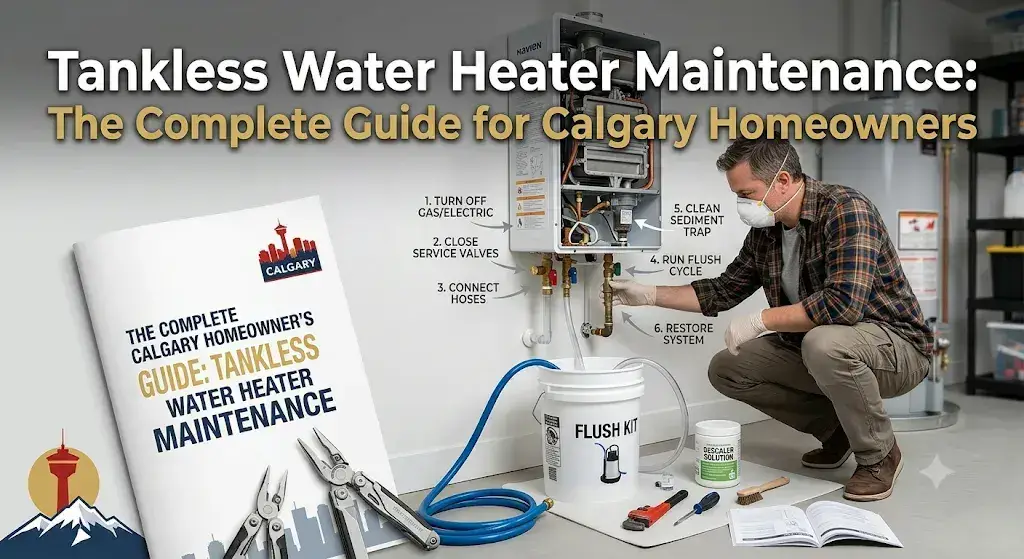
Flushing, also called descaling, is the most important maintenance task. It dissolves mineral buildup and rinses it out of the heat exchanger. Many homeowners hire a plumber for this, but here is how the process works so you know what to expect.
You will need:
- A small submersible pump (a basic utility pump works)
- Two hoses with the right fittings for your unit’s service valves
- A 5-gallon bucket
- About 4 litres (1 US gallon) of food-grade white vinegar, or a manufacturer-approved descaling solution
- Safety gloves and eye protection
Steps:
- Turn off the power and gas. Switch off the electrical supply and close the gas valve (for gas models). Let the unit cool down fully.
- Close the water valves. Shut off the cold-water inlet and the hot-water outlet to isolate the unit.
- Connect the hoses. Attach one hose from the pump to the cold-water service valve and the other from the hot-water service valve back into the bucket.
- Add the descaling solution. Pour the vinegar or descaling solution into the bucket.
- Open the service valves. Open both isolation valves so the solution can circulate through the heat exchanger.
- Run the pump. Circulate the solution for 45 to 60 minutes. For heavy scale, you may need a longer cycle.
- Flush with clean water. Drain the vinegar, then rinse the system with fresh water until it runs clear.
- Clean the inlet filter. Remove the filter screen, rinse off debris and reinstall it.
- Restore service. Close the service valves, reopen the main isolation valves, turn the power and gas back on, and run a hot tap to confirm normal operation.
Important: Tankless units involve gas, electrical and venting components. In Alberta, work on gas appliances must be done by a licensed professional, and incorrect servicing can void your warranty or create safety risks. If you are not completely comfortable with any step, call a plumber.
The Full Tankless Water Heater Maintenance Checklist
Flushing is only one part of a proper service. A thorough tune-up includes:
1. Clean the inlet water filter
The small screen at the cold-water inlet catches sediment before it reaches the heat exchanger. A clogged screen reduces flow and can cause lukewarm water or error codes. Check it every few months, especially if you have had recent water main work in your area.
2. Inspect the air intake and exhaust vent
Gas tankless units need clean combustion air and a clear exhaust path. Dust, lint, insect nests, snow or ice can restrict airflow and cause poor combustion or shutdowns. Make sure nothing is stored near the unit and the vent terminal outside is clear.
3. Check gas supply and combustion
A professional will test gas pressure, inspect the burner and check combustion quality. If you ever smell gas, leave the home and call your gas utility immediately. For suspected leaks, see our guide on gas line leak detection and repair.
4. Inspect the condensate drain (condensing models)
High-efficiency condensing units produce acidic condensate that drains away. A blocked drain or neutralizer can trigger shutdowns, so it should be checked yearly.
5. Look for leaks and corrosion
Inspect water connections, valves and the unit’s casing for drips, rust or mineral staining. Small leaks are cheap to fix now and expensive later.
6. Check temperature and flow settings
Confirm the set temperature is correct (around 49°C or 120°F is a common safe setting) and that flow rates match your household demand.
7. Review error code history
Many modern units store past error codes. A technician can read them to spot recurring problems before they become failures.
8. Update firmware or controls (where applicable)
Some smart models allow setting updates and recirculation pump adjustments that improve performance and efficiency.
9. Protect against freezing
In winter, make sure the unit’s freeze protection is working, the room stays above freezing and exposed pipes are insulated. Our winter-proofing checklist covers other cold-weather steps for your home.
DIY Maintenance vs. Professional Service
What most homeowners can do:
- Keep the area around the unit clear and clean
- Check and rinse the inlet water filter
- Look for visible leaks, rust or error codes
- Keep exterior vents clear of snow, debris and nests
What should be left to a licensed professional:
- Descaling the heat exchanger (best done with the right pump, fittings and valves)
- Gas pressure and combustion testing
- Venting inspection and repairs
- Condensate system service
- Any work involving the burner, circuit board, sensors or heat exchanger
Professional service also gives you a documented maintenance record, which helps with warranty claims and adds value if you sell your home. For a broader look at servicing any hot water system, see our guide on how to maintain your water heater.
How Much Does Tankless Water Heater Maintenance Cost?
Costs vary based on your brand, how accessible the unit is, how long it has been since the last flush and how much scale has built up. A routine annual service is usually a small fraction of the cost of a major repair or heat exchanger replacement, which is why regular maintenance pays for itself. For an accurate price for your home, contact ProStar Plumbing & Heating for a quote, and ask about financing options if a larger repair or upgrade is needed.
Warning Signs Your Tankless Water Heater Needs Attention
Do not wait for the annual service if you notice any of these:
- Lukewarm or inconsistent water temperature, which often points to scale or a clogged filter
- Reduced hot water flow or pressure
- Error codes on the display
- Strange noises such as rumbling, popping or whistling, usually from mineral buildup
- The unit cycles on and off repeatedly
- Higher gas or electricity bills with no change in usage
- Rusty or discoloured hot water
- Visible leaks or water around the unit
- A gas smell or soot around the unit (treat this as an emergency)
Our article on the top signs you need water heater services in Calgary walks through more symptoms to watch for, and this guide on warning signs of hot water system failure can help you judge how urgent the problem is.
Maintenance, Repair or Replacement: What Is the Right Call?
Maintenance fixes minor buildup and keeps a healthy unit healthy. If your heater already shows symptoms, you are likely looking at repair:
- Routine maintenance is right when the unit works normally and it has been a year since the last service.
- Repair is right when you have error codes, temperature swings, leaks or noises. Our tankless water heater repair service covers diagnosis and fixes for all major brands.
- Replacement makes sense when the unit is near or past 20 years old, the heat exchanger is damaged or repair costs keep climbing. If it is time for a new system, see our tankless water heater installation page, or read about energy-efficient water heater replacements to compare options.
If you have a conventional tank instead, our hot water tank repair page has you covered.
Frequently Asked Questions About Tankless Water Heater Maintenance
How often should a tankless water heater be flushed?
Once a year is the standard recommendation. In Calgary’s hard water, flushing every 6 to 12 months is safer, particularly if you do not have a water softener.
Can I use vinegar to descale my tankless water heater?
Yes. Food-grade white vinegar is widely used to dissolve scale, circulated through the unit with a small pump for 45 to 60 minutes. Always check your manufacturer’s instructions first, because some brands recommend specific descaling products.
What happens if I never maintain my tankless water heater?
Scale builds up in the heat exchanger, reducing efficiency and hot water output. Eventually the unit may overheat, throw error codes or fail early, and the manufacturer may refuse warranty coverage for a neglected system.
Do tankless water heaters need maintenance if I have a water softener?
Yes, but less often. A softener greatly reduces scale, yet filters, venting, gas components and combustion still need yearly inspection.
How long does a tankless water heater last with proper maintenance?
With regular care, most units last around 20 years, which is roughly double the lifespan of a typical tank-style heater.
Is tankless water heater maintenance worth it?
Absolutely. A yearly service costs far less than repairing or replacing a heat exchanger, and it keeps your energy bills lower and your hot water consistent.
Book Tankless Water Heater Maintenance in Calgary
Regular tankless water heater maintenance is the easiest way to protect your investment, cut energy costs and avoid cold showers on a freezing January morning. ProStar Plumbing & Heating provides tankless water heater servicing, descaling, repairs and installations for homeowners across Calgary and the surrounding communities, including Airdrie, Chestermere, Cochrane and Okotoks. You can see our full coverage on our service areas page.
If your unit is due for a flush, is showing warning signs, or you simply want peace of mind before winter, contact our team today to schedule your service. For urgent problems, our emergency plumbing team is ready to help.