Updated November 2026
Quick Answer: An HVAC system is the equipment that heats, ventilates, and cools a home. It usually includes a furnace or heat pump, an air conditioner, ductwork, a thermostat, and filters working together. HVAC stands for heating, ventilation, and air conditioning. In Calgary, a natural gas furnace paired with central air is the most common setup.
Most homeowners only think about their HVAC system when it stops working, usually on the coldest night of winter or the first hot day of summer. Knowing what the system is made of, and how the pieces work together, makes every later decision easier, from scheduling maintenance to choosing a replacement.
This guide explains HVAC in plain language: what the term means, how it differs from air conditioning, the main parts, how heating and cooling actually work, the types of systems available, and what suits a Calgary home.
What Does HVAC Stand For?
HVAC stands for heating, ventilation, and air conditioning. Together, those three functions control temperature, airflow, and air quality inside your home.
- Heating warms the home, usually with a furnace, a heat pump, or a boiler.
- Ventilation moves fresh air in and stale air out through ducts, fans, and sometimes a heat recovery ventilator.
- Air conditioning cools the air and removes humidity in summer, using an air conditioner or a heat pump.
HVAC vs. Air Conditioning: What’s the Difference?
People often use “HVAC” and “air conditioning” as if they mean the same thing. They don’t. Air conditioning is one part of an HVAC system.
| Air conditioning | HVAC system | |
| What it does | Cools and dehumidifies | Heats, cools, and ventilates |
| Typical equipment | Outdoor condenser and indoor evaporator coil | Furnace or heat pump, air conditioner, ductwork, thermostat, filters, ventilation |
| When it runs | Mainly in summer | Year-round |
If someone asks about “HVAC and air conditioning,” they usually mean the full heating and cooling setup. If you only need cooling, see our AC installation service. For the whole picture, our HVAC services in Calgary cover heating, cooling, and the equipment in between.
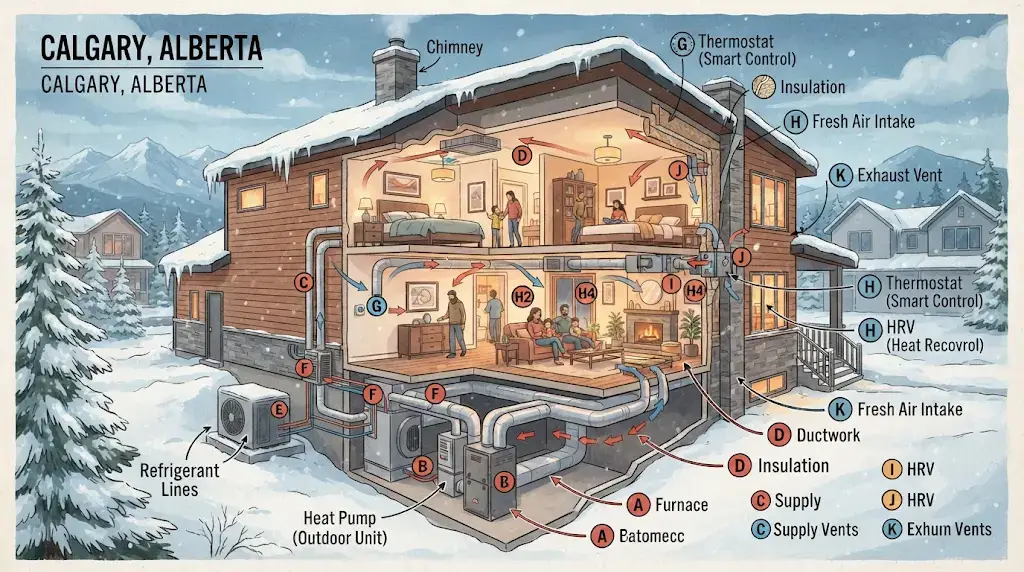
The Main Parts of an HVAC System
Every home is a little different, but most systems share these components.
| Part | What it does |
| Thermostat | The control. It senses room temperature and tells the equipment when to run. |
| Furnace | Heats air by burning natural gas (or using electricity) and passing air over a heat exchanger. |
| Air conditioner | Uses an outdoor condenser and an indoor evaporator coil to remove heat from indoor air. |
| Heat pump | One unit that heats and cools by moving heat in the right direction. |
| Blower (air handler) | The fan that pushes air through the ducts. |
| Ductwork and vents | The network that carries air to each room and returns it to the system. |
| Air filter | Traps dust and protects the equipment. |
| Ventilation equipment | A heat recovery ventilator (HRV) or similar unit brings in fresh air. Many newer homes have one. |
Filters and ventilation also affect what you breathe. Our guide to indoor air quality explains how they fit in.
How an HVAC System Works
How a Gas Furnace Heats Your Home
- The thermostat senses the room is colder than your setting and signals the furnace.
- The burners ignite and warm the heat exchanger. Combustion gases are vented outside and never mix with your indoor air.
- The blower pushes household air across the heat exchanger and into the ducts.
- Warm air flows out of the supply vents, while cooler air returns through the return vents, passes the filter, and repeats the cycle.
How an Air Conditioner Cools Your Home
- The thermostat calls for cooling and refrigerant circulates between the indoor coil and the outdoor unit.
- The indoor coil absorbs heat and moisture from your indoor air.
- The compressor sends that heat to the outdoor condenser, which releases it outside.
- The blower distributes the cooled air through the ducts.
How a Heat Pump Does Both
According to Natural Resources Canada, a heat pump is fully reversible. In summer it works like an air conditioner. In winter it moves heat from the outdoor air into your home instead of generating heat by burning fuel.
Types of HVAC Systems
Split System: Furnace and Central Air
This is the setup most people picture. A gas furnace handles heating, and a central air conditioner shares its ductwork for cooling. It is familiar, widely serviced, and well suited to homes that already have ducts and natural gas. See furnace installation for details.
Air-Source Heat Pump
A heat pump replaces both the furnace and air conditioner with one system. Natural Resources Canada notes that cold-climate air-source heat pumps are designed to work well below freezing, down to about -30°C, while conventional models rely on backup heat in colder weather. Learn more in our heat pump pros and cons and heat pump installation guide, or see our heat pump installation service.
Hybrid (Dual-Fuel) System
A hybrid system pairs a heat pump with a gas furnace. The heat pump handles most heating and all cooling, and the furnace steps in during extreme cold. Natural Resources Canada describes hybrids as a lower-cost way to add a heat pump, especially if you already have a newer furnace.
Ductless Mini-Split
A mini-split has an outdoor unit and one or more wall-mounted indoor units, with no ducts. It suits additions, converted spaces, and homes without ductwork. If your home has no ducts, ask your contractor whether a ductless option is practical.
Boiler and Radiant Systems
Some older homes heat with hot water through radiators or in-floor tubing. Cooling is usually handled by a separate system.
| System type | Best for | Trade-offs |
| Furnace plus central air | Homes with ducts and natural gas | Two separate pieces of equipment to service |
| Air-source heat pump | Replacing an old AC and cutting gas use | Cold-weather performance depends on the model and sizing |
| Hybrid | Homes with a newer furnace | More components and a more complex setup |
| Ductless mini-split | Additions and ductless homes | Many indoor units may be needed for whole-home comfort |
| Boiler and radiant | Existing hydronic homes | Cooling is usually separate |
Which HVAC System Fits a Calgary Home?
No single system is best for every house. These Calgary factors matter most:
- Cold winters. Heating performance matters more than cooling. A system must be sized to carry your home through the coldest weeks.
- A short cooling season. Calgary has fewer hot days than many cities, but heat waves happen. Natural Resources Canada notes that moving from a cooling-only unit to a heat pump is often a small added cost when you are replacing an air conditioner anyway.
- Natural gas access. Where gas is inexpensive, Natural Resources Canada’s analysis found heat pump operating costs closer to those of a gas furnace. That is why a hybrid system is worth asking about. Homes without gas, such as some acreages in Bearspaw, Springbank, and Balzac, compare heat pumps with propane or electric heat.
- Ductwork and home age. Older homes may need duct changes, and tighter newer homes depend on ventilation.
- Proper sizing. An oversized or undersized system wastes energy and wears out faster. A good contractor sizes equipment with a load calculation, not a rule of thumb.
When you compare equipment, you will see efficiency ratings. Furnaces use AFUE (the share of fuel turned into heat). Air conditioners and heat pumps use SEER2 for cooling, and heat pumps use HSPF2 for heating, as explained on the ENERGY STAR air-source heat pump page. Higher numbers mean better efficiency.
For what the process looks like once you decide, read what HVAC installation involves.
How Long Does an HVAC System Last?
| Equipment | Typical lifespan |
| Gas furnace | 15 to 20 years |
| Air conditioner | 10 to 15 years |
| Heat pump | 10 to 15 years |
These are typical figures with regular maintenance. If your equipment is approaching these ages and repairs are piling up, our guides on warning signs it’s time to replace your furnace and the repair-or-replace rule for AC can help you decide.
How Much Does an HVAC System Cost?
Most Calgary homeowners pay roughly $5,000 to $15,000 for a complete new system, depending on home size, equipment type, and ductwork. Replacing only a furnace or only an air conditioner costs less. Our HVAC system cost guide for Calgary breaks down the numbers by equipment type and home size.
Signs Your HVAC System Needs Attention
You do not need to be an expert to notice trouble. Watch for:
- Rooms that are too hot or too cold
- Rising energy bills with no change in use
- Strange noises, such as banging, grinding, or squealing
- The system turning on and off repeatedly
- Weak airflow from the vents
Our common HVAC problems and warning signs guide explains what each one usually means. When something fails, ProStar handles furnace repair, AC repair, and heat pump repair.
Keeping Your HVAC System Running Well
Two habits do most of the work. Replace or clean your air filter every one to three months, depending on the filter and your household. And book a professional tune-up each year so small problems get caught before they become breakdowns. Our guide on how often to schedule HVAC maintenance explains what each system needs, and our tips for improving furnace efficiency show where small changes pay off.
When to Call a Professional
Filters and thermostat settings are safe for homeowners. Gas, electrical, and refrigerant work are not. Call a licensed technician if:
- You smell gas or notice soot near the furnace
- The system will not start or keeps shutting off
- You are planning a replacement or switching system types
- You want help comparing contractors, which our guide to choosing an HVAC contractor in Calgary makes easier
Frequently Asked Questions
What does HVAC stand for?
HVAC stands for heating, ventilation, and air conditioning. The term covers the equipment that controls temperature, airflow, and air quality in a building, including the furnace, air conditioner or heat pump, ductwork, thermostat, and filters.
Is HVAC the same as air conditioning?
No. Air conditioning only cools and dehumidifies. An HVAC system includes heating and ventilation as well, so an air conditioner is one component of a full HVAC system.
What are the main parts of an HVAC system?
The main parts are the thermostat, furnace or heat pump, air conditioner, blower, ductwork and vents, air filter, and ventilation equipment. They work together to heat, cool, and move air through the home.
What is the most common type of HVAC system in Calgary?
A natural gas furnace paired with a central air conditioner is the most common setup. Heat pumps and hybrid systems are also worth considering, especially when you are replacing an older air conditioner.
Do heat pumps work in Calgary winters?
Cold-climate heat pumps are designed to work well below freezing, down to about -30°C, according to Natural Resources Canada. Performance depends on the model and sizing, and many homes keep a furnace as backup in a hybrid system.
How long does an HVAC system last?
Gas furnaces typically last 15 to 20 years, while air conditioners and heat pumps last about 10 to 15 years. Regular maintenance helps equipment reach the upper end of those ranges.
How often should an HVAC system be serviced?
Most manufacturers recommend a professional check at least once a year for each system. Heat pumps, which run year-round, often benefit from checks in both heating and cooling seasons.
How do I know what size HVAC system I need?
A contractor should calculate it from your home’s size, insulation, windows, and layout in a load calculation. Square footage alone is not enough, and a wrongly sized system wastes energy and wears out sooner.
Get Help Choosing or Servicing Your HVAC System
ProStar Plumbing & Heating has served Calgary homeowners since 1996, with licensed technicians, flat-rate pricing, and no overtime charges. Explore our full range of HVAC services in Calgary, or ask about financing for a new system.
We serve Calgary, Airdrie, Chestermere, Cochrane, Okotoks, Springbank, Bearspaw, Crowfoot, Balzac, De Winton, Conrich, Delacour, and West Hills. See all areas we serve.
Ready to talk? Contact us or call (403) 250-7232.